A step-by-step company analysis that teaches you how to apply the MaxDividends strategy in real life.
Learn Dividend Investing One Stock at a Time
Table of Contents
Cummins Inc (CMI)
The real question is not whether Cummins is a high‑quality enterprise.
The question is:
Does CMI belong in your portfolio today — or is it a company to monitor patiently for a more compelling entry point?
In this Deep Dive, Cummins goes through the MaxDividends Five‑Pillar Formula — the same structured framework we use to evaluate whether a business can sustain and grow its dividend through recessions, cyclical end‑markets, technological transitions, and periods of uneven global growth.
Let’s break it down — step by step.
How This Company Makes Money?
Do I clearly understand how Cummins Inc. earns its money — and does the business make sense?
Cummins generates revenue through a diversified power solutions model: by designing, manufacturing, and servicing engines, components, and energy systems embedded in heavy‑duty trucks, industrial equipment, power generation assets, and infrastructure projects worldwide. It serves OEMs, fleet operators, distributors, and end users across more than 190 countries. The core drivers:
1️⃣ Engine Segment
This segment produces diesel and natural gas engines used in heavy‑ and medium‑duty trucks, buses, construction and mining equipment, agriculture, and marine applications. Demand is supported by freight activity, infrastructure investment, and replacement cycles tied to aging fleets. A large global installed base creates ongoing service and parts revenue that extends well beyond the initial equipment sale.
2️⃣ Components
Cummins supplies turbochargers, filtration systems, fuel systems, aftertreatment solutions, and drivetrain technologies — many of which are used both in its own engines and across third‑party platforms.
3️⃣ Power Systems
This segment delivers power generation equipment, including standby and prime power generators for data centers, healthcare facilities, utilities, and industrial sites. These applications often serve mission‑critical environments where reliability is non‑negotiable, supporting steady demand for both equipment and long‑term service agreements.
4️⃣ Accelera and Energy Transition Solutions
Through its growing portfolio of electrified and alternative power technologies — including battery systems, fuel cells, and hydrogen solutions — Cummins is positioning itself for evolving regulatory and customer requirements.
The key strength is that Cummins operates at the center of a vast global fleet of trucks, machines, and power assets that require continuous maintenance, regulatory upgrades, and performance optimization. Its products sit inside essential equipment that keeps freight moving, infrastructure operating, and backup power available when it matters most.
This is not a short‑term cyclical trade — it is a scaled power technology platform built around mission‑critical applications, diversified end markets, and recurring service demand that can provide resilience across shifting economic and regulatory environments.
? And yes — this business model is simple, understandable, and makes perfect sense.
Is This a Good Stock to Buy Long Term?
Has the company shown the kind of consistency and resilience a long‑term dividend strategy needs?
The MaxDividends approach focuses on reliable businesses that are capable of increasing their dividends year after year. The longer you hold them, the more income they can consistently generate for your portfolio — without the need for constant trading or adjustments.
The MaxDividends Strategy Checklist – Simple Steps to Pick the Right Stocks
Step 1: Dividend History
Our filter: Companies with 15+ years of consistent dividend growth.
Cummins doesn’t just clear the bar on dividend consistency — it demonstrates the kind of long, compounding upward trajectory dividend investors seek. And it achieves this in a business anchored by essential power solutions and a global service network rather than transient capital projects. CMI’s annual dividend per share climbed from roughly $1.25 in the early 2010s to approximately $7.60 today. That steady progression signals a payout supported by robust cash generation and a management culture that views the dividend as a permanent priority.
For a global powertrain and energy solutions provider exposed to freight demand cycles, heavy‑duty truck production volatility, commodity price swings, currency moves, evolving emissions standards, and the strategic complexity of transitioning toward electrified powertrains, such consistency is not automatic. It indicates Cummins has produced sufficient free cash flow across diverse macro environments to sustain annual increases even when end markets soften or investment demands peak.
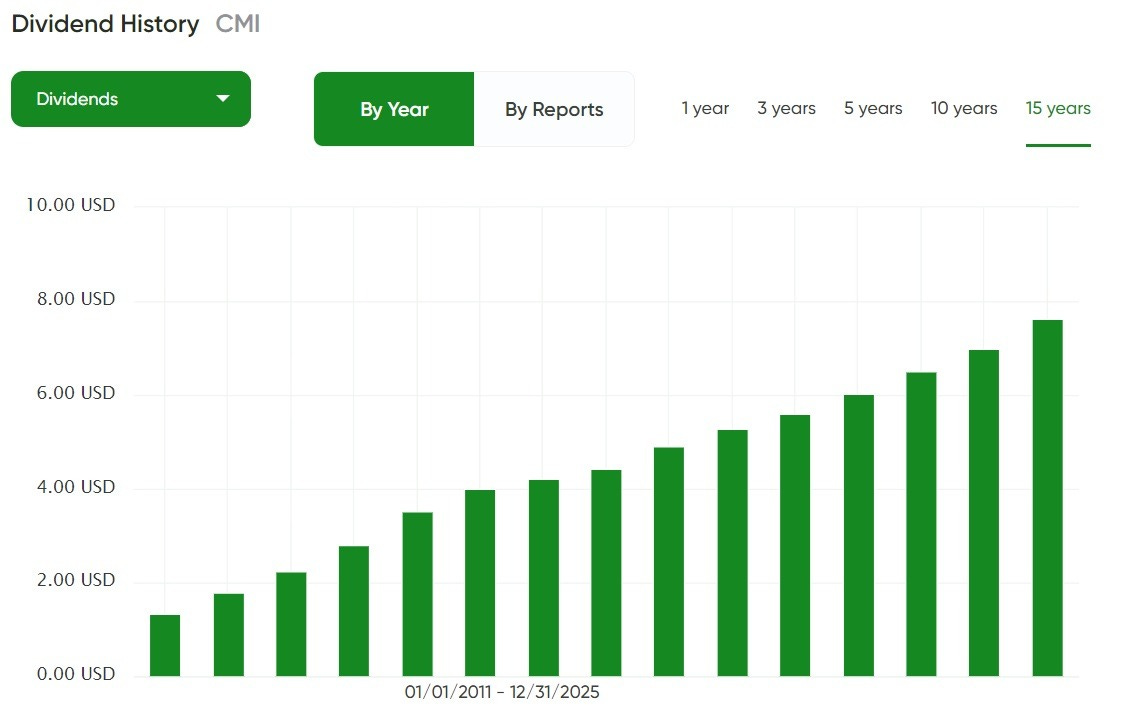
✅ Step 1 passed — Cummins Inc (CMI) behaves like a Dividend Eagle, with a resilient dividend‑growth record that strengthens its case as a credible long‑term dividend‑growth holding.
Step 2: The Five-Pillar Secret Formula
1️⃣ Sales Growth – The Foundation of a Strong Business
On a 10‑year view, Cummins’ revenue expanded from roughly $17B in the mid‑2010s to the low‑$30B range most recently. The trajectory was not perfectly smooth — exactly what investors should expect. CMI operates in markets shaped by heavy‑duty truck production cycles, global freight demand, commodity costs, currency movements, emissions regulation changes, and fluctuations in industrial and power generation spending. Despite those variables, the long‑term revenue base has grown materially.
That pattern aligns with Cummins’ operating model. The company does not rely on a single engine platform or a temporary upcycle in truck builds. Growth comes from strengthening relationships with OEMs and fleets, expanding its components and aftertreatment portfolio as emissions standards evolve, increasing penetration in power generation markets such as data centers and healthcare, and monetizing a large installed base through parts and service.
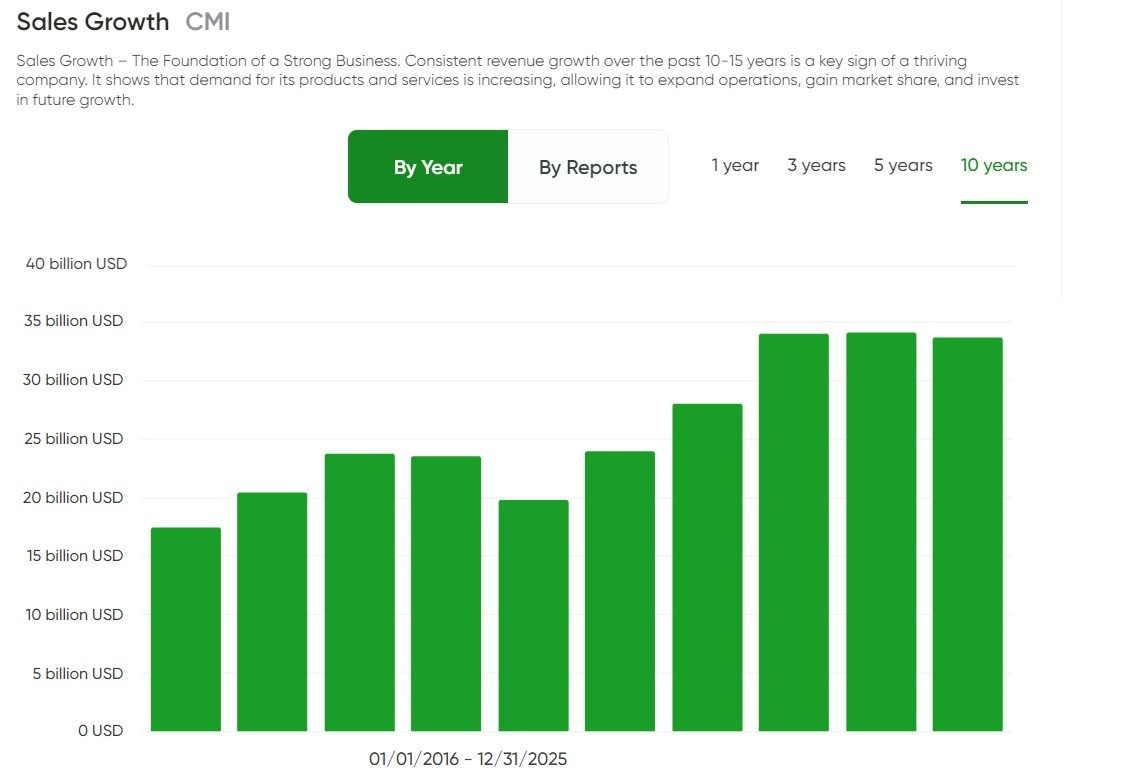
✅ Sales Growth passed — Cummins’ durable long‑term revenue trend reinforces its case as a diversified power solutions platform with a credible foundation for sustained dividend continuity.
2️⃣ Profit Growth – The Fuel for Dividend Growth
Cummins’ profit trajectory tells an equally important story for dividend investors: earnings power has strengthened over time, even without a perfectly linear climb. Over the past decade, profit growth increased from roughly $4–5B in the mid‑2010s to more than $8B in recent years. That progression suggests CMI is not dependent on a single exceptional truck cycle, but supported by a profit engine capable of expanding through freight volatility, regulatory change, and global economic swings.
Profit durability is reinforced by operating leverage in higher‑volume years, disciplined cost management, productivity initiatives across manufacturing, and an increasing mix of components, aftertreatment systems, and service revenue tied to a large installed base. A meaningful share of demand is connected to keeping commercial fleets, industrial equipment, and standby power systems operational — needs that remain essential even when new equipment orders slow.
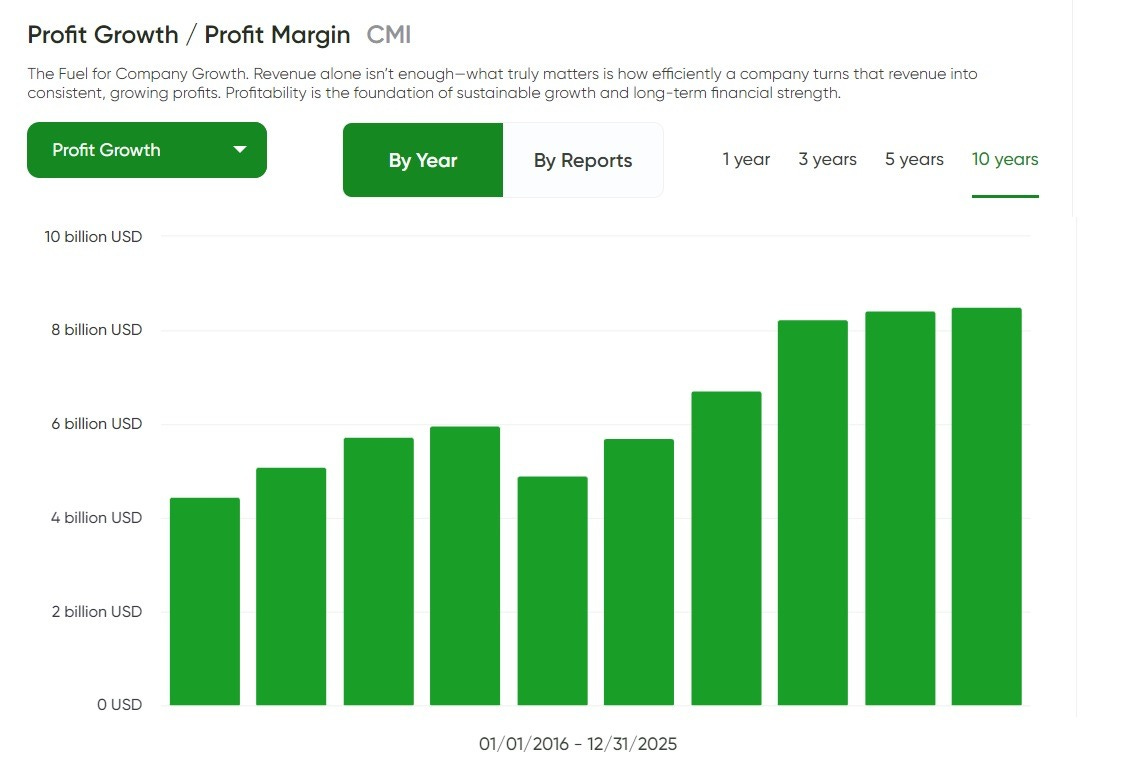
✅ Profit Growth passed — Cummins’ expanding earnings base strengthens the reliability of its dividend foundation.
3️⃣ Net Income – True Measure of Strength
Cummins’ net income pattern presents the kind of profile dividend investors should examine closely: a consistently profitable company exposed to real economic cycles, yet resilient enough to navigate them. Over the past decade, net income starts near roughly $1.0–$1.5B in softer years, climbs into the $2.0B–$2.5B range during stronger operating periods, and reaches close to $4.0B at its recent high before moderating again.
That variability is not a flaw — it is a reflection of the markets Cummins serves. The company operates within heavy‑duty truck production cycles, global freight trends, commodity cost pressures, emissions regulation shifts, and regional industrial demand changes. For dividend investors, the key question is not whether earnings fluctuate, but whether profitability remains intact across downturns and continues to compound over time without a structural breakdown. In Cummins’ case, the long‑term earnings trajectory indicates that it does.
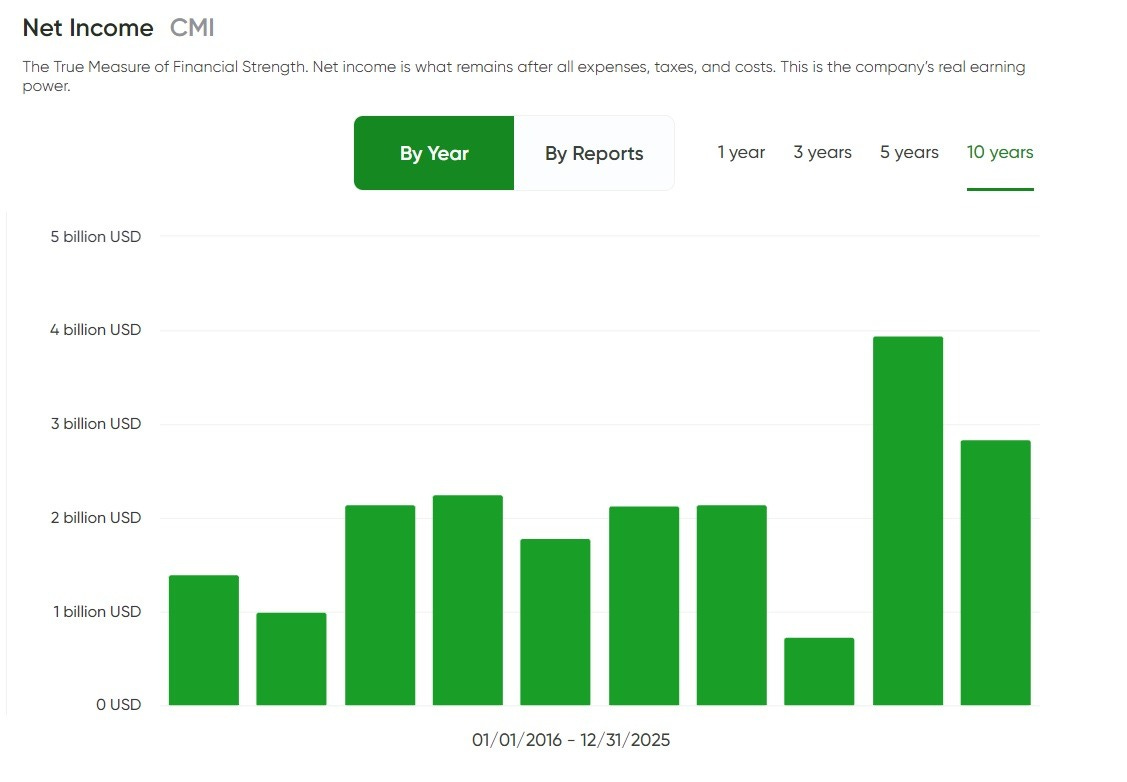
✅ Net Income passed — Cummins demonstrates a resilient and cycle‑tested earnings profile over the decade, reinforcing that its dividend growth rests on durable operating strength rather than a temporary surge.
4️⃣ Dividend Payout Safety – Protecting Passive Income
Cummins’ payout ratio does not follow a perfectly smooth path — but over time it has generally remained within a range dividend investors can evaluate with confidence, with occasional compression and temporary spikes reflecting the realities of a cyclical industrial business. Across the past decade, the ratio has typically moved between roughly 30% and 50% in stronger earnings years, with one notable surge above 100% during a period of sharply reduced profits. While fluctuations are present, the broader pattern indicates that the dividend is not structurally disconnected from the company’s earning capacity.
That distinction matters. This is not the profile of a company chronically stretching to fund its dividend. Instead, it reflects a management team that maintains a steady dividend policy while the earnings denominator shifts — influenced by heavy‑duty truck cycles, freight slowdowns, commodity cost pressures, and occasional one‑time charges that can temporarily depress net income. In Cummins’ case, the sharp rise in the payout ratio appears primarily linked to cyclical earnings compression rather than an aggressive change in dividend policy. As profitability recovered, the ratio moved back toward more typical levels.
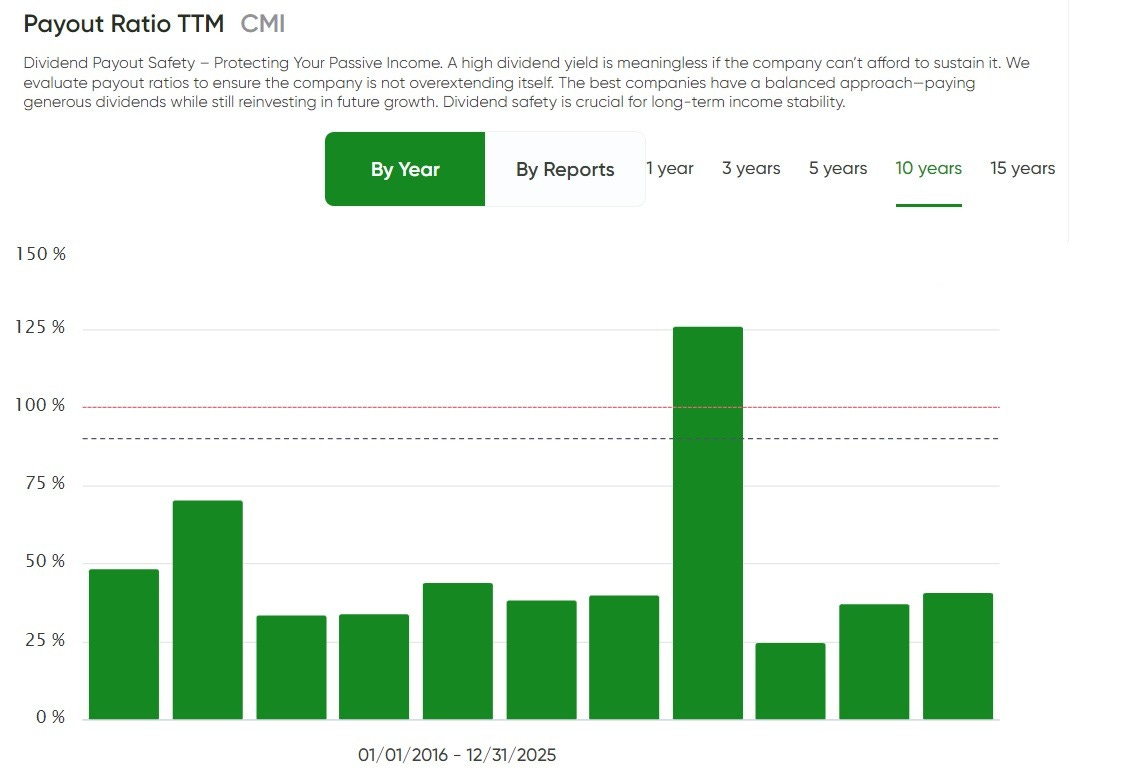
⚠️ Dividend payout safety — Over the past 10 years, Cummins’ payout ratio has at times exceeded 100%. Although it has since returned to a more sustainable range, those spikes underscore the need to monitor coverage during cyclical downturns, as extended periods above 100% could pressure financial flexibility and future dividend growth.
5️⃣ Debt Burden – Avoiding Financial Traps
Cummins does employ debt, and that by itself is not a red flag for dividend investors. The real issue is whether leverage stays within a manageable corridor over time. On a 10‑year view, CMI’s debt ratio has generally ranged from the low‑0.5 area to just under 0.7 at its peak, and most recently sits close to 0.60. That pattern points to a balance sheet operating within a reasonable band for a global manufacturer exposed to cyclical end markets and ongoing investment needs.
For a company tied to heavy‑duty truck production, power generation demand, emissions technology development, and the capital requirements of an energy transition strategy, leverage can shift with working capital cycles, acquisition activity, and temporary earnings volatility. Yet the overall trajectory does not suggest escalating strain.
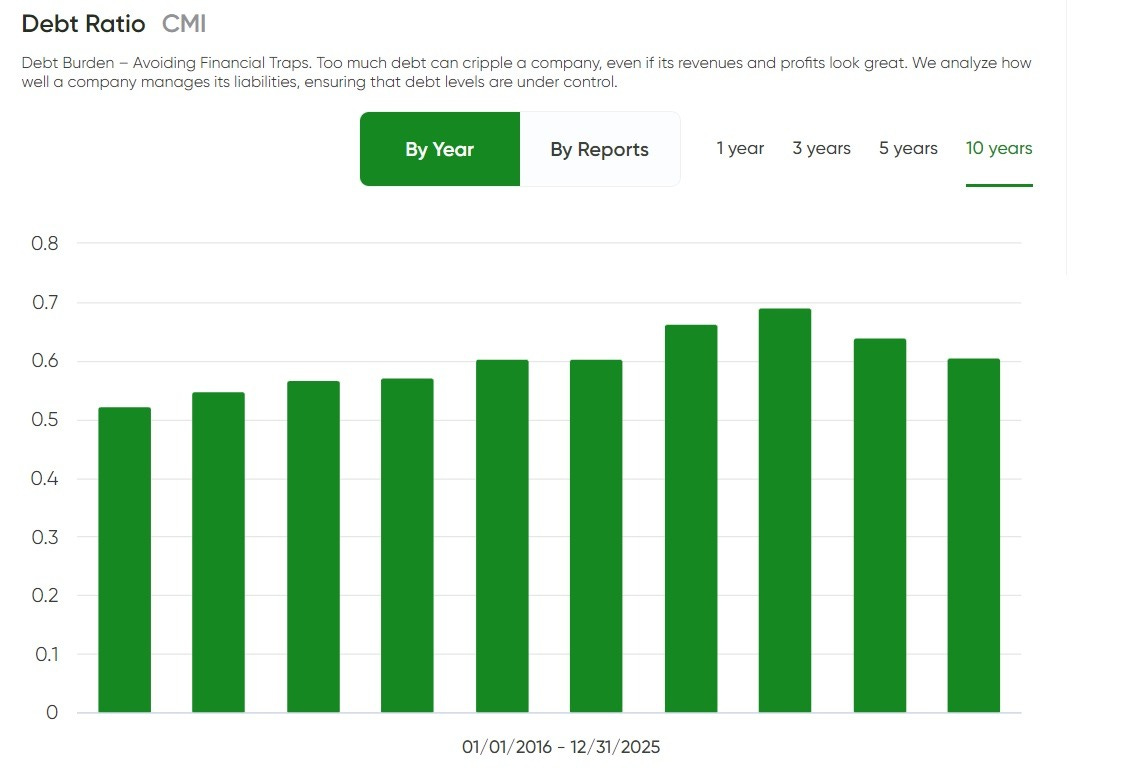
✅ Debt burden passed — Cummins’ leverage profile appears controlled, reinforcing the view that its dividend is supported by balance‑sheet discipline rather than excessive financial risk.
Bottom Line: The Company Financial Condition?
Financial Score 90+ ✅
Think of this as a concise snapshot of overall business resilience. The higher the rating, the more stable and dependable the company tends to be across shifting economic environments. A score above 90 typically reflects a high‑quality enterprise designed to endure — and with Cummins at 98, the takeaway is straightforward: CMI exhibits strong core fundamentals, cycle‑tested durability, and the kind of operational strength dividend investors look for in long‑term holdings.

MaxDividends Five-Pillar Secret Formula. Step 2 – ✅
Viewed through our Five‑Pillar Secret Formula, Cummins emerges as a credible dividend‑growth candidate for long‑term income investors — a company that has broadened its revenue base across freight and industrial cycles, reinforced profitability through changing demand and regulatory environments, maintained a generally disciplined payout policy, and achieved an exceptionally strong overall financial rating.
The MaxDividends Financial Score represents the concise expression of that same five‑pillar discipline, giving you an at‑a‑glance assessment of business quality while the full analytical framework continues working beneath the surface.
✅ Passed: Cummins Inc. — Proven Dividend Eagle ?
Does It Fit My Plan?
Finding the Right Role for Every Dividend Stock – MaxRatio
Dividend investing is not a one-size-fits-all approach. Different dividend stocks serve different purposes: some are geared toward long-term wealth creation through compounding, others strike a balance between income and capital appreciation, while a smaller group is focused primarily on generating immediate cash flow.
MaxRatio was created to help investors distinguish between these roles. Rather than relying on market narratives, it evaluates what a stock is truly offering by combining three essential metrics: current dividend yield, dividend growth rate, and financial strength.
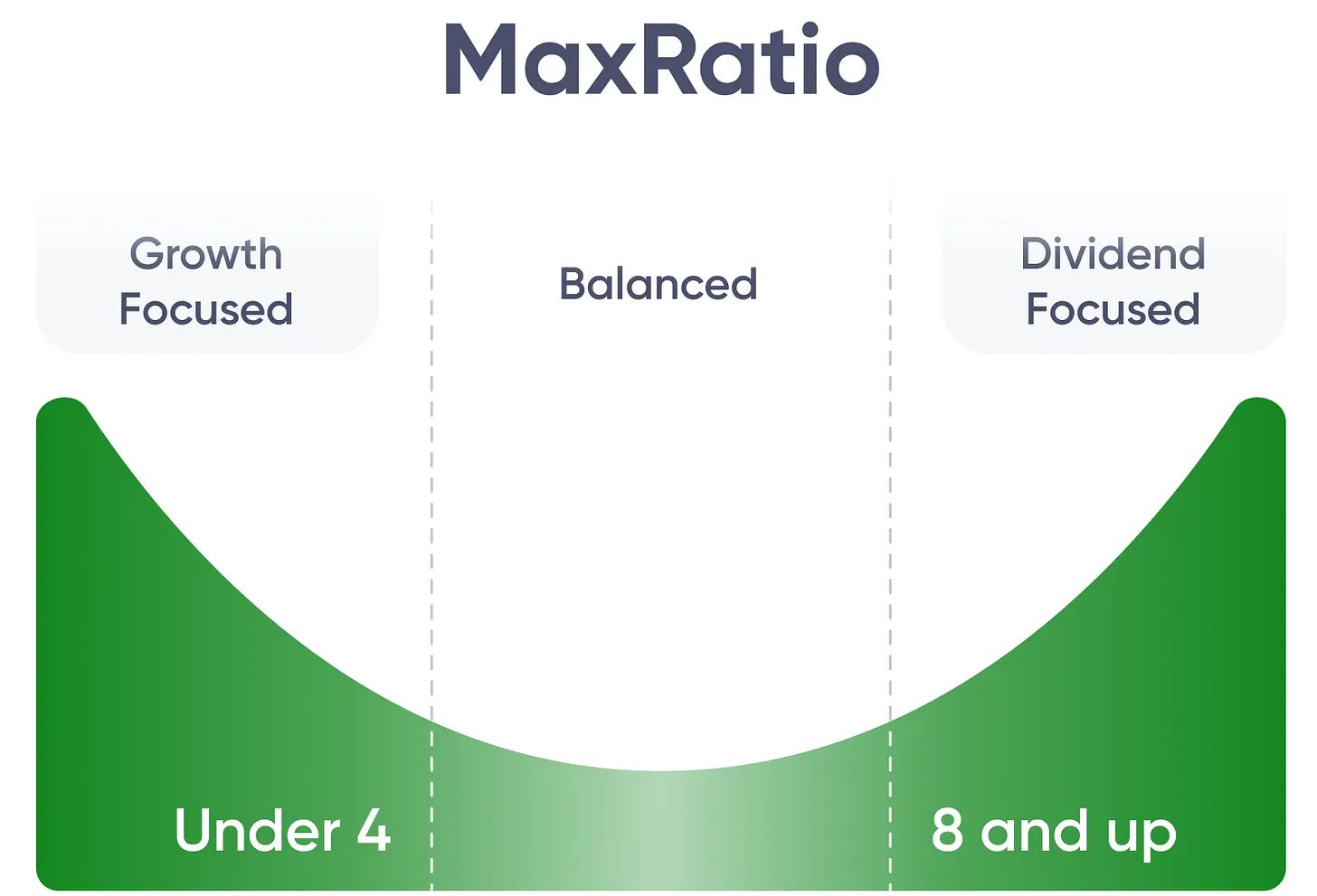
These three dimensions together tell you whether a stock should function as your growth accelerator, a steady value creator that compounds both gains and income, or your primary cash machine.
- ? Growth Eagles (MaxRatio below 4) — These prioritize appreciation. Current yields may look modest, but they signal a healthy, durable business. You’re building serious long-term wealth while your dividend quietly compounds into tomorrow’s income stream.
- ⚖️ Balanced Eagles (MaxRatio 4–8) — The middle path. You earn meaningful dividends right now while watching those payments climb steadily, creating compounding on both your capital and your cash receipts.
- ? Income Eagles (MaxRatio 8+) — Pure income generators. These deliver fat yields today while adding steady, predictable growth — the perfect choice if your priority is hassle-free, dependable cash production.
MaxRatio exists for one reason: it lets you place each dividend holding into its proper role and assemble a portfolio that mirrors your personal objectives — whether you’re chasing explosive growth, seeking balanced gains plus regular payments, or maximizing today’s passive income stream.
Let’s Take Pool Cummins Inc. (CMI)
Inside the MaxDividends app, go to Company Analytics. There, you can review any stock on your watchlist and view both the Financial Score and MaxRatio side by side, without navigating across multiple tabs.
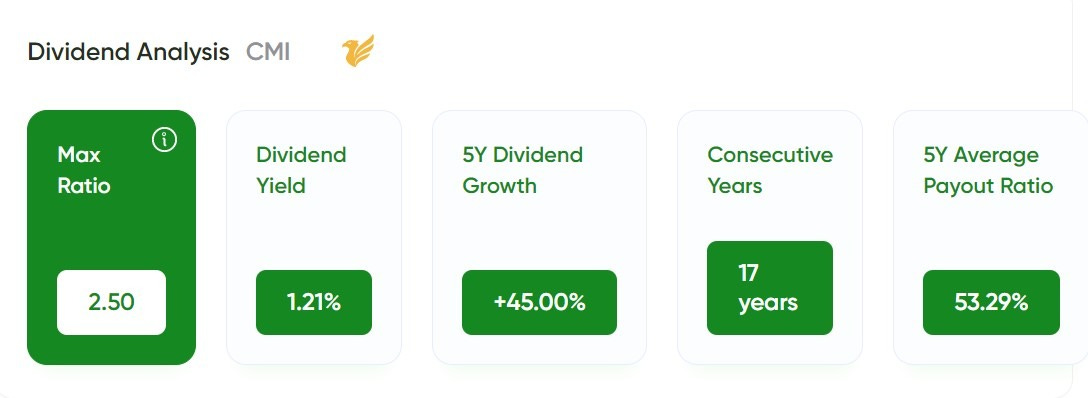
With a MaxRatio of 2.50, a dividend yield of 1.21%, and cumulative dividend growth of 45.00% over the past five years, Cummins falls into the Growth Eagles category. That classification indicates CMI is best approached as a dividend‑growth story rather than a high‑current‑income position.
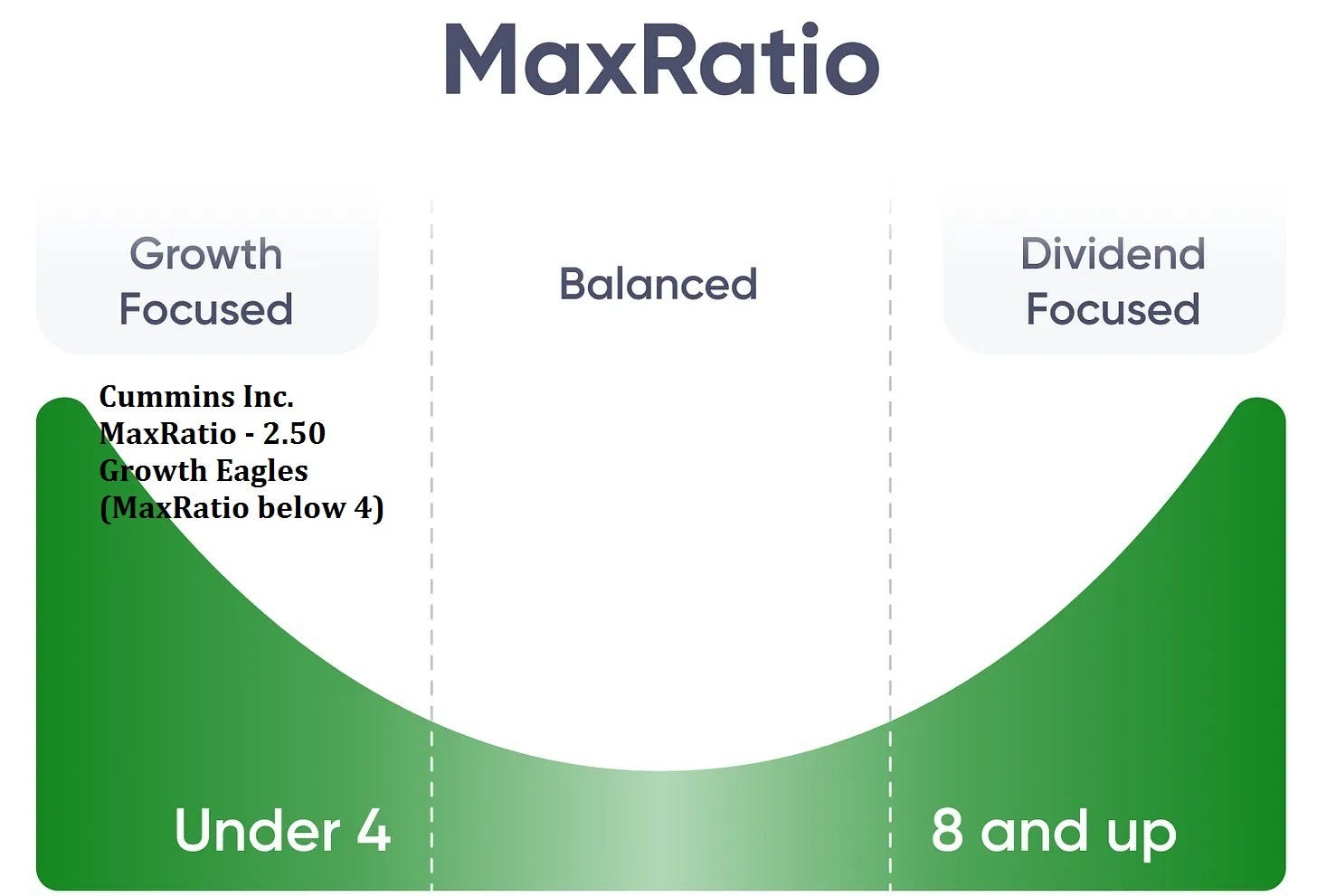
The yield is moderate, but the combination of consistent annual increases and a balanced MaxRatio highlights a structure where dividend expansion — not headline yield — supports long‑term total return. This is the type of dividend stock that may appeal to investors seeking steadily rising income backed by a financially durable industrial franchise. Cummins is not designed to serve as a high‑yield bond alternative, but it can act as a long‑term compounding vehicle, where disciplined capital allocation, resilient margins, and exposure to essential power and transportation markets underpin sustainable dividend growth.
? Is the Stock Undervalued Today?
Cheaper than competitors?
✅ In the MaxDividends App, Cummins currently screens as Fairly Valued relative to its peer group.
The implication is that, at the current price, the market is valuing CMI largely in line with its earnings capacity, balance‑sheet strength, and operating performance compared with other companies in the sector.
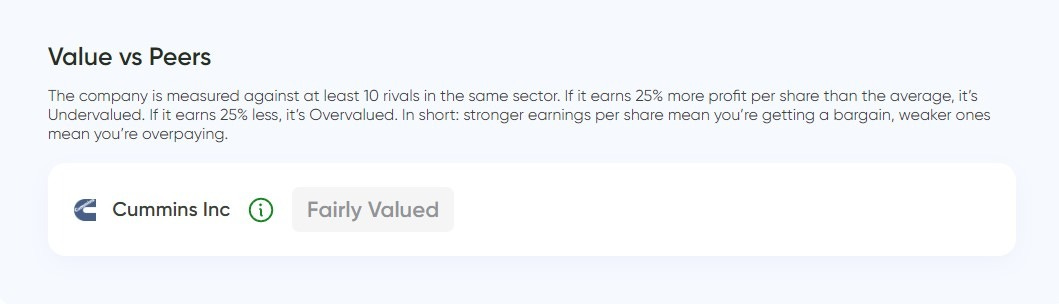
In simple terms: you’re paying a reasonable price for a high‑quality power and industrial franchise, rather than acquiring it at a pronounced discount or an evident premium. For investors centered on steady compounding and dividend reliability, Cummins may deserve attention on the basis of quality and consistency — even if it is not presently signaling a deep‑value opportunity relative to peers.
Cheaper than its own history?
⚠️ More expensive vs. its own 10-year average.
Over the past decade, Cummins has generally traded at an average P/E in the high‑teens to low‑20s range. Today, the multiple stands meaningfully above that historical norm, indicating that the stock is priced richer than its own long‑term average. In practical terms: investors are currently paying more than usual for each dollar of CMI’s earnings.
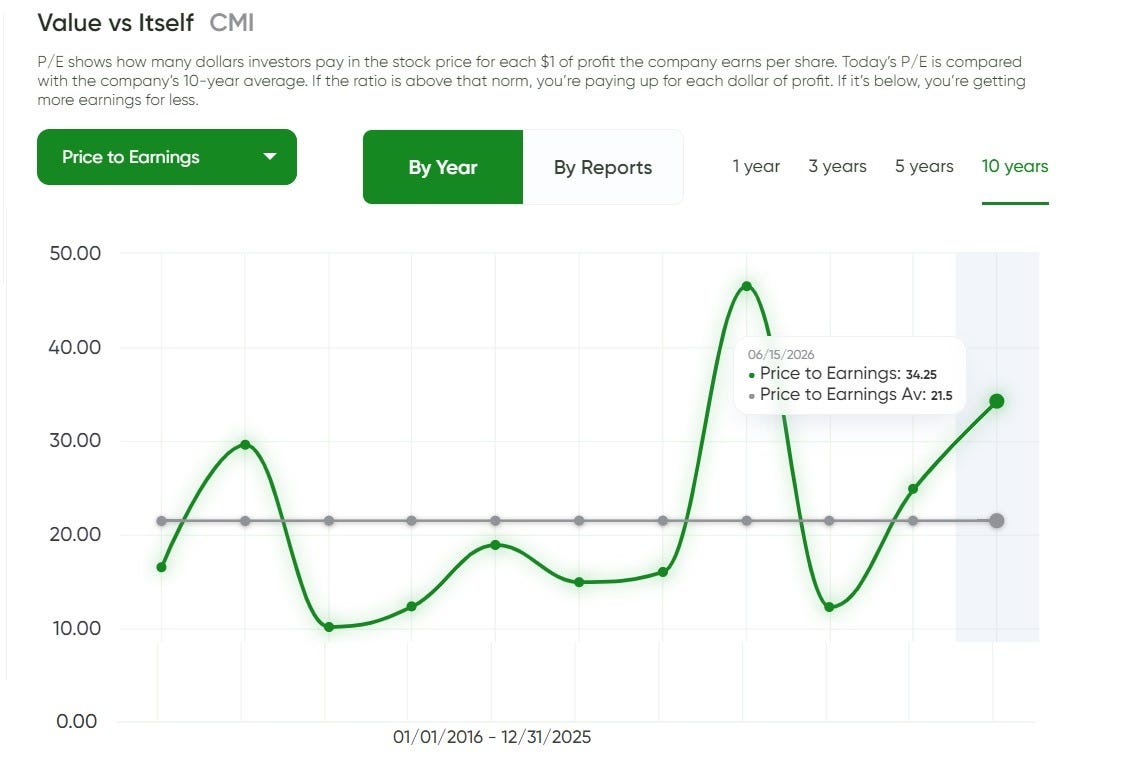
That does not automatically make Cummins an unattractive dividend holding — but it does shift the focus toward valuation awareness and entry discipline, rather than viewing the shares as a clear “quality at a discount” opportunity.
Better Yield Than Usual?
⚠️ Yield below its long-term average.
Today, Cummins’ dividend yield is approximately 1.21%, below its longer‑term average of around 2%. In simple terms, investors are receiving less income than they typically have at past valuation levels.
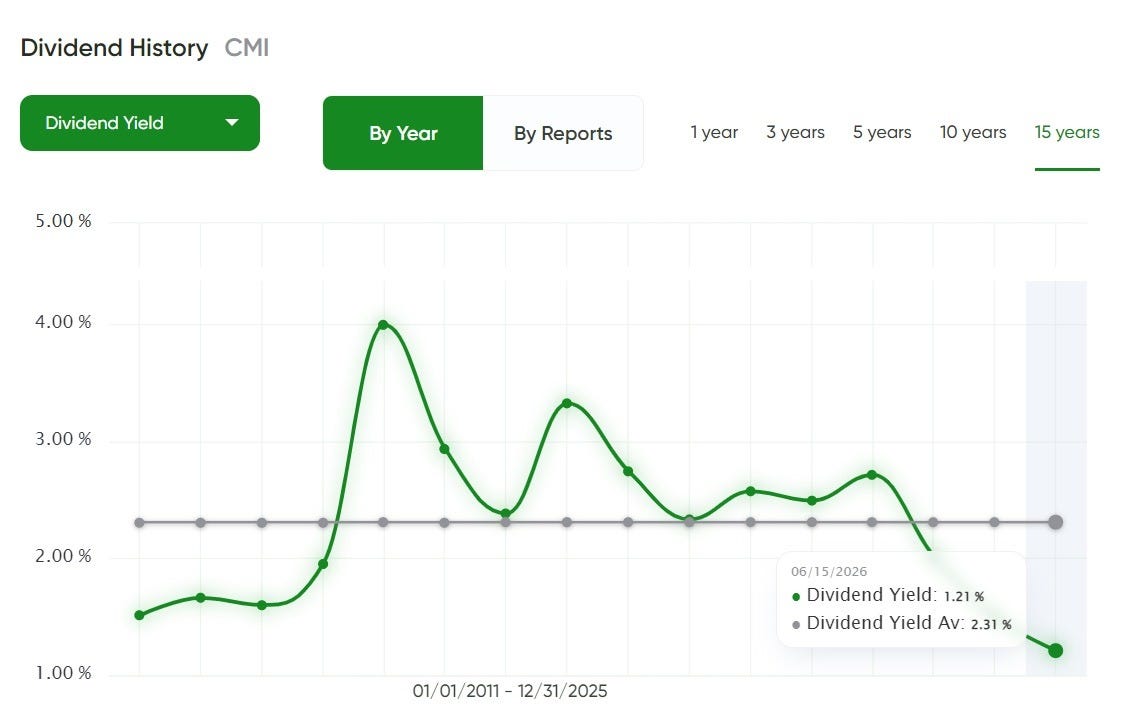
That dynamic usually occurs when the share price advances faster than the dividend itself or when the market assigns the stock a higher earnings multiple. CMI’s yield has historically fluctuated with cycles — rising during periods of price weakness and compressing when sentiment and valuation expand. The current reading fits that pattern: as the P/E moves above its historical norm, the yield tightens, even though the dividend continues to grow in absolute terms.
Analyst Consensus
✅ Analysts do see short‑term upside for Cummins Inc. (CMI).
The consensus 12‑month price target for Cummins is approximately $740.12, implying about +8.89% upside from the current level. The projected range remains relatively wide — from a low near $520.00 to a high around $850.00.
For dividend investors, that prospective appreciation adds another dimension to the story. CMI is not solely a “collect the dividend and wait” holding; it also offers potential for capital gains if freight demand stabilizes, heavy‑duty truck production remains healthy, and the company continues executing on margin discipline and energy transition initiatives.
Is This One for Me?
Do I clearly understand how Cummins Inc. earns its money — and does the business make sense to me?
Yes: Cummins is a global provider of engines, power systems, and related technologies serving heavy‑duty trucks, industrial equipment, and critical infrastructure. Its products are embedded in a vast installed base of vehicles and power assets that require ongoing maintenance, replacement parts, and service support, generating recurring aftermarket demand backed by engineering depth and operational reliability.
Is This a Good Stock to Buy Long Term?
Has the company shown the kind of consistency and resilience I want to see?
? Yes: 17 consecutive years of dividend increases and a shareholder‑return philosophy that has held up across freight cycles, emissions transitions, and global economic slowdowns. Cummins has moved through truck production downturns, commodity volatility, regulatory shifts, and heavy investment phases while continuing to raise its dividend. That consistency reflects disciplined capital allocation and an earnings base supported by a large installed fleet requiring parts, service, and compliance upgrades — even when new equipment demand softens.
Is the Stock Undervalued Today? ?
? According to the MaxDividends App, Cummins is screening as Fairly Valued relative to its peer group, while trading above its own 10‑year average valuation multiple, and its current dividend yield of 1.21% remains below its longer‑term historical average of roughly 2%.
Does It Fit Your Plan?
Dividend stocks do not all play the same role in a portfolio. My framework centers on companies that either generate meaningful income today while steadily expanding it, or begin with a moderate yield and compound that payout consistently over time. With a MaxRatio of 2.50, a current dividend yield of 1.21%, and 17 consecutive years of dividend increases, Cummins fits more naturally into the Dividend Compounders category.
That places CMI as an attractive option for dividend investors who value long‑term income growth over maximizing immediate yield. The starting yield is moderate, but when combined with a solid history of increases, balanced payout coverage, and a business model anchored by recurring service and parts demand across transportation and power systems, it offers a structured path toward building rising income through full economic cycles.
Final Take
I have considerable respect for Cummins and the way it has established itself as a mission‑critical power solutions provider across transportation, industrial, and infrastructure markets, supplying the engines and systems that keep a vast global fleet operating year after year. It fits naturally within a MaxDividends‑style portfolio: not a speculative headline story, but a scale‑driven engineering franchise supported by recurring service demand, technical expertise, and long‑term OEM and fleet relationships.
CMI also presents a balanced setup in the current environment. In the MaxDividends app it screens as Fairly Valued relative to peers, indicating the market is pricing it broadly in line with comparable industrial names. At the same time, the shares trade above their own long‑term average valuation multiple, and the current dividend yield of 1.21% sits below its historical norm near 2%, which suggests investors are paying a reasonable — though not discounted — price for quality while accepting a lower‑than‑typical starting yield.
Cummins remains exposed to global freight cycles, heavy‑duty truck production, emissions regulation shifts, and capital‑spending trends across regions. If economic activity or equipment demand slows more than expected, the dividend appears supported, but total returns could moderate as valuation and growth expectations recalibrate. For dividend‑growth portfolios, CMI can still warrant a meaningful allocation as a long‑term compounder where disciplined execution and recurring aftermarket demand help sustain rising income over time.