
- Dividend growth investing enables you to create a stable source of passive income that grows over time.
- Investing in cheap dividend-growth stocks can increase both the average dividend yield and the total investment income of a portfolio.
- High-quality companies that have increased their dividends for decades demonstrate lower volatility than growth stocks. A long history of paying dividends to shareholders is a sign of financial stability and effective management.
- In 2026, the average dividend yield of the S&P 500 Index fell below 1.1%. Nevertheless, it was still possible to find affordable stocks with growing dividends on the stock exchange.
- Searching for undervalued dividend stocks combines the strategies of value investing and income investing.
This article will provide examples of the best cheap dividend stocks and explain the factors to consider when building a portfolio.
The #1 Platform for Dividend Investors
Top Dividend Stocks & ETFs • Buy/Hold/Sell Ratings • Dividend Safety Scores • Income Strategies • Dividend Tracker • Premium Research
? Questions? Ask the Community →
Table of Contents
What Makes Dividend-Growth Stocks Attractive Today
Cheap blue-chip dividend stocks are shares in quality companies whose market price is below ‘fair value’. The market undervalues them due to temporary problems affecting the company or industry. This can also be a consequence of an economic crisis.
However, these securities offer the same dividend growth stocks benefits. They provide investors with inflation protection through regularly increasing cash flow.
Before buying a cheap valuation stock, it is necessary to ensure that the company:
- Has economic moats. These significant competitive advantages allow it to maintain and grow its market share. They also enable it to pass on cost increases to consumers without risking reduced demand.
- Demonstrates financial stability. Primary attention is paid to fundamental metrics. These include the debt-to-equity ratio and the payout ratio, among others.
- Has a strong dividend track record, meaning it has consistently paid and increased dividends over several decades.
Cheap dividend stocks with high potential are shares in quality companies that are currently experiencing temporary difficulties. In the long term, however, they are characterized by low volatility and provide shareholders with cash flow, even during periods of crisis.
Top 10 Cheap Dividend-Growth Stocks to Buy Now
The table below shows undervalued dividend growth stocks.
| Name (Ticker) | Morningstar economic moat rating | Fair value according to Morningstar | Price to fair value | Forward dividend yield |
| Becton Dickinson (BDX) | Narrow | $225 | 0.63 | 2.87% |
| Medtronic (MDT) | Narrow | $112 | 0.73 | 3.54% |
| S&P Global (SPGI) | Wide | $570 | 0.73 | 0.9% |
| Mondelez International (MDLZ) | Wide | $73 | 0.83 | 3.22% |
| Elevance (ELV) | Narrow | $474 | 0.83 | 1.73% |
| Marsh (MRSH) | Narrow | $197 | 0.84 | 2.13% |
| Cigna Group (CI) | Narrow | $338 | 0.85 | 2.14% |
| UnitedHealth Group (UNH) | Narrow | $427 | 0.95 | 2.28% |
| Duke Energy (DUK) | Narrow | $131 | 0.96 | 3.38% |
| EOG Resources (EOG) | Narrow | $139 | 0.96 | 3.09% |
The selection of cheap dividend stocks is based on Morningstar’s fair value estimates. The listed companies are included in the Morningstar US Dividend Growth Index. Given the selection criteria for this index, the provided list can be considered a selection of the best cheap dividend stocks 2026. However, this is not an investment recommendation. Let’s now take a closer look at each company.
Becton Dickinson (BDX) a producer of medical devices, instruments, reagents. Results for the period ending March 31, 2026 showed a loss. According to experts, this is due to market barriers, declining revenue in the Life Sciences and biological sciences segments, and weak demand for vaccine delivery devices. It tops the list of cheap dividend stocks in terms of undervaluation.
Medtronic manufactures and sells medical devices and technologies. However, experts rate its core business highly. This cheap dividend stock is dividend aristocrats. The company has potential to maintain and increase dividends.
S&P Global (SPGI) is a financial data, ratings, and benchmark provider. Over the past six months, the stock has declined by more than 18%. The reasons include slower growth in key business segments, disappointing fiscal 2025 earnings results, and broader market factors. The company is a dividend aristocrat with a payout ratio of just 24.35%
Mondelez International is a manufacturer of food products, snacks, and confectionery. In 2025, the company’s net income declined by more than 46%, primarily due to high raw material costs. Analysts expect performance to improve as market conditions stabilize. Morningstar director Erin Lash forecasts that the company will increase its dividends by 7–9% annually over the next eight years.
Elevance Health, Inc. is one of the largest health insurance companies in the United States. Like other companies in the industry, ELV is expected to face regulatory challenges in 2027 due to Medicaid program cuts and other factors. However, Morningstar analysts believe that the company’s strong balance sheet supports a valuation significantly above current stock price levels.
Marsh operates in the fields of risk management, insurance, consulting, and investment solutions. Over the past 12 months, the company’s stock price has fallen by nearly 25%. The reasons include declining global commercial insurance rates and rising macroeconomic risks. One of the company’s key strengths is its substantial free cash flow.
The Cigna Group specializes in healthcare services and insurance. Its shares have declined by nearly 25% over the past year. This valuation is largely driven by regulatory concerns. Morningstar analysts highly regard the company’s financial flexibility and its ability to generate earnings.
UnitedHealth Group is another major player in the health insurance industry. Its stock price has risen by 41% over the past three months. Despite this rally, Morningstar analysts believe the company is still trading below its fair value. The company has strong financial stability, with a debt ratio of 0.67, and has increased its dividend for 16 consecutive years.
Duke Energy is an energy holding company engaged in the generation and distribution of electricity and natural gas. The company has increased its dividend for 21 consecutive years. Morningstar Senior Analyst Andrew Bischof expects dividend growth to reach 4% annually in the future.
EOG Resources is engaged in the exploration, development, production, and marketing of crude oil, natural gas, and natural gas liquids. From a dividend investor’s perspective, the company’s strengths include a moderate payout ratio of 39.68% and a high 5-year dividend CAGR of 22.80%.
Understanding the Morningstar US Dividend Growth Index
The Morningstar Dividend Growth Index is a good place to start when choosing which stocks to buy. It includes 396 companies. The securities included are selected based on the following characteristics:
- Dividend growth criteria. A company must have increased its dividends for at least five consecutive years. It is acceptable if a company did not increase dividends, but conducted a share buyback.
- Earnings forecasts. The index only includes companies with positive analyst expectations for net income.
- Payout ratio limits. In order to be included in the index, a company must have a payout ratio of less than 75%.
The resulting list excludes the top 10% of companies with the highest payout yields. This is done to reduce risk and increase growth potential. REITs (real estate investment trusts) are also excluded from the index, even if they meet the criteria.
Not all of the companies included in the Morningstar US Dividend Growth Index offer cheap dividend stocks. Some of them may be overvalued. Therefore, additional analysis is necessary when selecting individual securities. However, it is possible to invest in the entire index through the iShares Core Dividend Growth ETF (DGRO).
Take, for instance, the broad market. When compared to the S&P 500 ETF Trust (SPY), DGRO pays higher dividends. Its TTM dividend yield is 1.94%, compared to 0.98% for SPY. However, DGRO lags behind in terms of total return. The chart below illustrates the total return over 10 years.
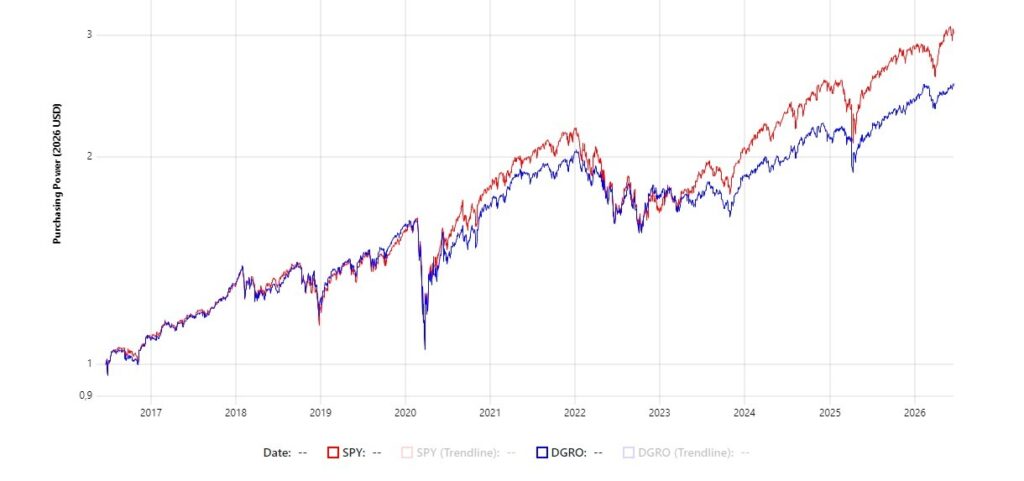
According to totalrealreturns.com
The Importance of Economic Moats in Dividend Growth Investing
Economic moats are significant competitive advantages that enable companies to demonstrate sustainable dividend growth. Examples include:
- network effect – the value of a product or service increases as its usage and customer base grow;
- switching costs – a customer will incur additional expenses (adjusted earnings) if they want to switch to a competitor;
- cost advantage – the company’s goods are cheaper to produce than those of its competitors.
Analysts use the term ‘narrow moat’ when they believe that a company will lose its key competitive advantages within ten years. ‘Wide moat’ indicates that a company’s advantages are likely to persist for at least 20 years.
High-Yield Dividend Growth Opportunities Under $10
Investors with limited funds often look for low-priced dividend stocks. Below is a list of high-yield dividend stocks that can also be considered affordable dividend stocks:
- Horizon Technology Finance (HRZN). The share price of this BDC (business development company) is $4.34. The dividend yield is 26.09%.
- Prospect Capital Corp (PSEC). The dividend yield is 19.09%, and the share price is $2.20. This is the cheapest dividend stock on the list.
- Orchid Island Capital Inc (ORC). This mortgage REIT offers a dividend yield of 17.91%. Its share price is $6.61.
- AGNC Investment Corp. (AGNC). The company is a mortgage REIT with a distribution yield of 13.98% and a share price of around $10.
- Western Union Co. (WU). The company specializes in international money transfers and provides financial services. Its dividend yield is 13.20%, with a share price of $7.12.
- PennantPark Floating Rate Capital (PFLT). This BDC primarily works with private or low-liquidity public companies and focuses on floating-rate loans. The dividend yield is 12.83%. At the time of writing this review, the share price was $7.58.
- Barings BDC (BBDC). The company lends to businesses in the middle market. It pays out some of its interest income to shareholders. This equates to a yield of 12.35% based on a share price of $8.24.
- Blue Owl Capital Inc. (OWL). Shares in this asset management company cost around $9.49. The dividend yield is 9.65%.
- Gladstone Land (LAND). This REIT owns agricultural land and farms. With a share price of around $8.65, the dividend yield stands at 6.47%.
- Flowers Foods Inc. (FLO). The company’s stock costs just over $7.3, and its dividend yield is 6.43%.
All of the cheap dividend stocks under $10, listed above, have dividend yields above 5%.
Among cheap dividend stocks under $5, Oxford Square Capital (OXSQ) is worth noting. This stock is currently trading at $1.33. The annual dividend is 42 cents per share. This gives an impressive yield of 31.34%, making OXSQ the highest-yielding security in this review.
Cheap dividend stocks under $1 can be found on the over-the-counter market. One example is Chesapeake Granite Wash Trust (CHKR), which has a yield of 18.47% and is priced at $0.35 per share.
The #1 Platform for Dividend Investors
Top Dividend Stocks & ETFs • Buy/Hold/Sell Ratings • Dividend Safety Scores • Income Strategies • Dividend Tracker • Premium Research
? Questions? Ask the Community →
Monthly Dividend Stock Opportunities
In order to provide shareholders with a monthly income, a company must have predictable earnings. REITs and BDCs therefore dominate the monthly dividend stocks market.
There are 119 companies on the full list of those that pay their shareholders monthly. The cheapest monthly dividends are paid by the following companies:
- Pine Cliff Energy Ltd. (PIFYF) – 1.44% with a price of $0.42;
- Petrus Resources Ltd. (PTRUF) – 7.78% with a price of $1.16;
- Permianville Royalty Trust (PVL) – 9.33% with a price of $1.80.
When it comes to cheap monthly dividend stocks and high yields, the leaders are Oxford Square Capital (OXSQ), PennantPark Investment Corporation (PNNT) Ellington Residential Mortgage (EARN).
Risk Considerations and Red Flags
Making investments in cheap dividend stocks carries a high level of risk. This is particularly the case for securities with exceptionally high yields of over 10%. One way to reduce dividend risk is to invest in cheap dividend aristocrat stocks. However, it is important to remember that even the best companies may implement dividend cuts.
In order to avoid yield traps, it is necessary to carry out a financial health assessment of the company. This includes:
- studying the dividend payment history;
- payout ratio analysis;
- comparing the debt/equity ratio and key multiples with industry averages;
- evaluating the dynamics of revenue, cash flow, and net profit.
Good cheap dividend stocks have increased their dividends continuously for at least five years. Their payout ratio is less than 75%, and their debt-to-equity ratio is no higher than 2. Revenue and profit also show positive dynamics.
When it comes to BDCs or mortgage REITs, net interest income is also a key consideration. For REITs that own real estate, however, important metrics include net operating income, funds from operations (FFO) and property operating expenses.
Building a Diversified Dividend Growth Portfolio
Effective risk management is essential for investing in cheap dividend stocks. There are two factors that contribute to dividend portfolio diversification. The first is sector allocation. The second is combining cheap high dividend stocks with those that pay growing dividends.
To increase income stability, preference is given to cheap high quality dividend stocks. These are known as dividend champions and dividend aristocrats. These are companies that have raised their dividends for over 25 consecutive years.
FAQ: Cheap Dividend-Growth Stocks
The dividend growth investing FAQ section contains answers to investment strategies and cheap dividend stocks questions. It also covers the topic of choosing between dividend yield vs growth.
H3: What are cheap stocks?
Cheap dividend stocks are those that pay dividends and whose market price is below their fair value. However, there is no infallible method for determining fair value. Therefore, investors risk buying a dividend trap rather than a good company with a low valuation.
H3: Is it worth buying cheap dividend stocks?
Cheap dividend stocks with growing dividends are suitable for a long-term strategy aimed at increasing cash flow and capital appreciation. Those with a need for cash income may prefer cheap dividend stocks with high payout yields. However, they should not constitute the entirety of a portfolio.
Which is better: a high yield today, or dividend growth over the years?
When building a well-diversified portfolio, it is advisable to include both types of cheap dividend stocks. The ratio of each type should be determined based on financial goals and investment horizons.
Article Sources
- Morningstar, Inc. (2024). “Morningstar US Dividend Growth Index Methodology.” Morningstar Indexes, detailing index construction criteria including five-year dividend growth requirements, 75% maximum payout ratios, and dividend-weighted portfolio methodology.
- Lefkovitz, D. (2024). “Bots, Barrels, Banks and Biopharma: Dividend Growth Performance Analysis.” Morningstar Indexes Research, analyzing dividend-growth stock underperformance versus technology-led markets and defensive characteristics during market downturns.
- Goldstein, S. (2024). “Specialty Chemicals and Agricultural Inputs Sector Analysis.” Morningstar Direct Research Database, covering Albemarle and FMC Corp fundamental analysis including lithium price recovery expectations and cyclical risk assessment.
- Utterback, J. (2024). “Healthcare Plans and Medical Instruments Equity Research.” Morningstar Equity Research, providing analysis on Humana, Baxter International dividend sustainability and leverage target assessments.
- Sure Dividend Research Database (2025). “Low-Priced High Dividend Stocks Analysis Report.” Sure Dividend LLC, comprehensive analysis of 14 dividend stocks trading under $10 with yields exceeding 5%, including REIT, BDC, and specialty company coverage.
- Ciura, B. (2025). “Monthly Dividend Stocks Valuation Analysis.” Sure Dividend Research, examining cheapest monthly dividend opportunities based on forward valuation multiples and 5-year annualized return projections.
- The Motley Fool Investment Research (2025). “High-Yield Dividend Growth Stock Analysis: Target, T. Rowe Price, Chevron.” Fool.com equity research covering retail, investment management, and energy sector dividend sustainability analysis.
- Morningstar Economic Moat Methodology (2024). “Competitive Advantage Assessment Framework.” Morningstar Investment Management, explaining narrow and wide moat rating criteria for sustainable competitive advantages and dividend growth sustainability.